Start with the job you need it to do
The most useful hair accessory is not necessarily the one with the strongest grip. It is the one that holds the right amount of hair in the right place without making you think about it all day. Before choosing a clip, tie, pin or headband, decide whether you want to keep a few strands off your face, secure a low ponytail or hold a full updo. An accessory that works beautifully for a small section may feel strained around all your hair.
Consider your hair’s length, thickness and texture alongside the style. Fine or slippery hair may slide out of a smooth clip, while a small clasp may not close comfortably around thick hair. Short layers can escape a ponytail even when the tie itself is secure. Those differences are not problems to overcome by pulling tighter; they are clues about which shape, size and placement to try.
Look for grip without sharp pressure
For hair ties, notice both the material and the amount of stretch. A tie that needs several tight wraps to hold can leave a pronounced crease and create an uncomfortable pulling sensation. A wider, soft-covered elastic or a well-sized scrunchie spreads pressure over a larger area. It may take a little experimentation to find one that holds without slipping, especially if you alternate between loose and polished styles.
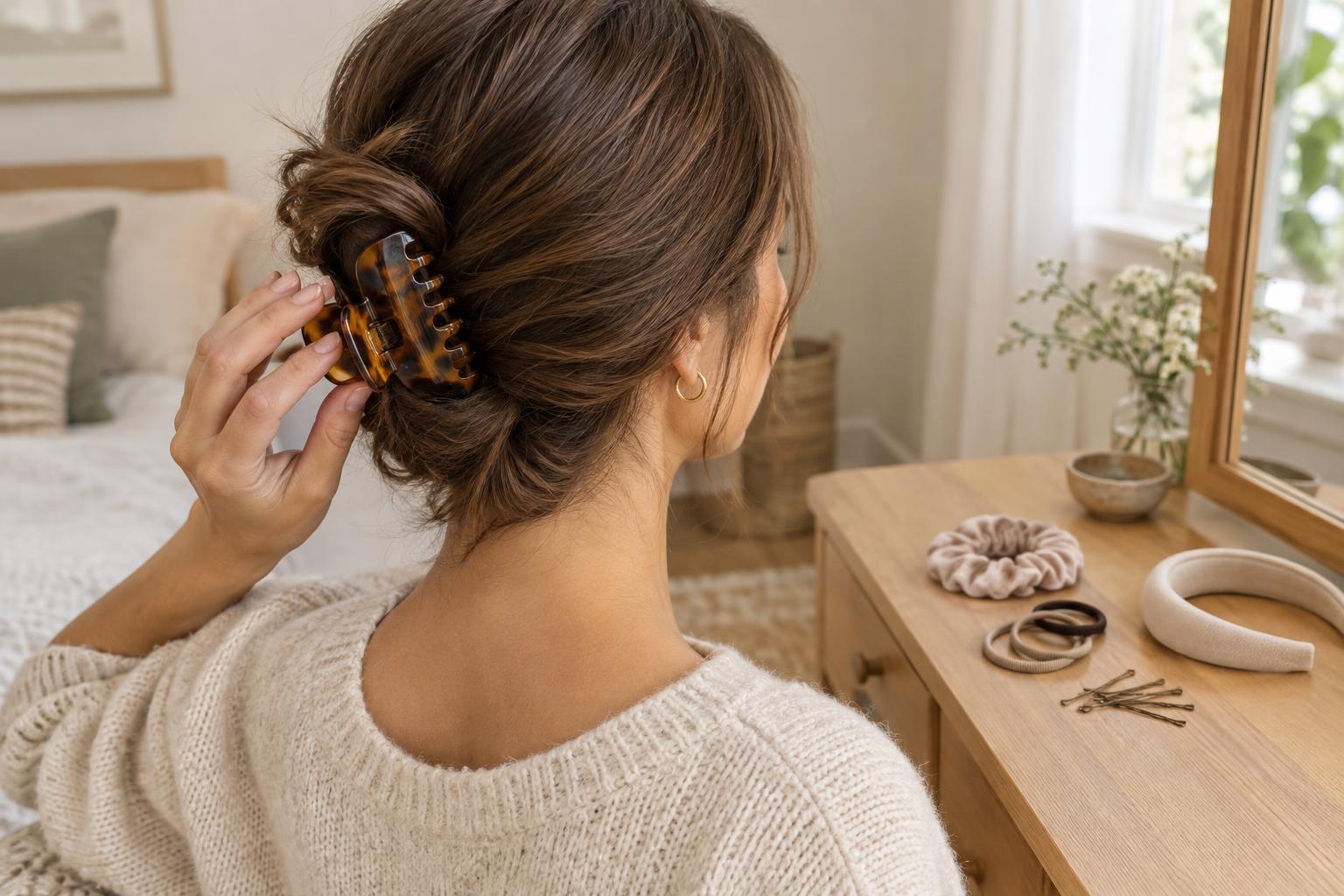
Clips should close fully around the hair they are meant to hold. If a claw clip is forced open by a thick twist, its teeth may dig in or the clip may pop loose. Try a larger clip, a smaller section of hair or a lower twist instead. For barrettes and snap clips, check that edges feel smooth and hinges do not catch strands as they open and close. A firm closure is useful; a closure that pinches hair or scalp is not.
Use placement to do some of the work
A secure style does not always require a tighter accessory. A low ponytail often puts less upward tension on the hair than a high one, while a clip positioned close to the base of a twist has less weight to fight. If a claw clip keeps falling, gather the hair, twist it gently and tuck the ends before closing the clip over the twist. If the clip feels heavy or tips backward, try placing it slightly lower rather than squeezing in more hair.
Pins can be especially useful for smaller sections or loose layers. Slide a pin in so that it catches some hair from the section you want to secure and some hair near the scalp, without pressing its tip against your head. Two pins placed at different angles may offer a steadier hold than one pin pushed in tightly. For a headband, choose a width and shape that sits comfortably behind the hairline; if it presses behind your ears, a different band may suit you better.
Test comfort as well as staying power
When you try a new accessory, wear it around the house before relying on it for a long day. Move your head, bend forward and sit back against a chair. Notice whether the accessory shifts, catches, feels bulky or creates a tender spot. A clip that stays put while you stand still may feel awkward against a headrest, and a headband that seems comfortable at first may press after an hour.
Pay attention when you take it out, too. An accessory should release without tugging out a cluster of hairs or requiring you to unwind strands from its hinge. Remove pins and clips slowly, and loosen a tie rather than dragging it down the length of your hair. If a style hurts, take it down and reset it more loosely. Discomfort is a useful signal that the tension or placement is not working for you.
Build a small collection you will actually use
You do not need a drawer full of accessories to cover everyday needs. A practical starting set might include a soft tie for a quick ponytail, a clip sized for your usual twist, and a few smooth pins for face-framing pieces. If you wear headbands, add one you can keep on comfortably for the length of time you normally need it. Choose pieces for the styles you repeat, not just the styles you hope to make.
Before replacing an accessory that slips, try changing one thing at a time: the amount of hair it holds, the position of the style or the way you gather your hair. If it still needs constant adjustment, it may simply be the wrong fit. The goal is a comfortable hold that fits into your routine, lets you move naturally and is easy to take down at the end of the day.