Start with the fabric and shape
A scarf’s fabric often matters more than the way you tie it. Soft, flexible fabrics tend to settle close to the body, while stiff weaves and chunky knits hold their shape and can stand away from a collar. If you want a streamlined look, try a scarf that you can fold easily in your hands. It can still feel substantial enough for the day; it simply needs to move with the clothes underneath it.
Size matters, too. A long, wide scarf gives you plenty of styling options but also leaves more fabric to arrange. A narrower rectangle or small square may be easier to manage with a jacket or layered outfit. Before buying a scarf, think about how you would usually wear it. If your preferred style involves one simple loop, you may not need enough length to wrap it around your neck several times.
Keep the wrap loose and the ends flat
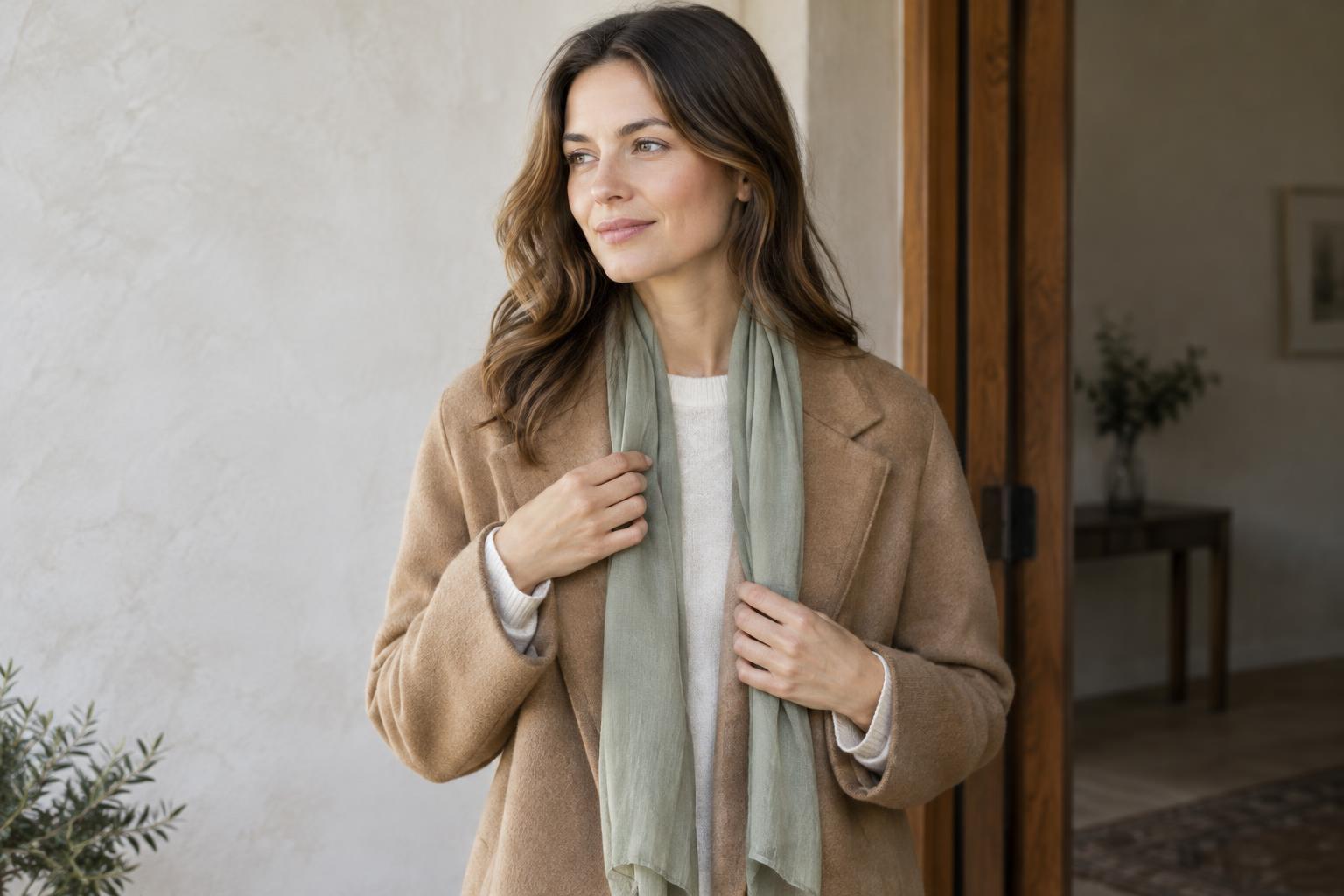
The simplest way to reduce bulk is to avoid gathering all the fabric at the front of your neck. Drape the scarf over your shoulders, with one end a little longer than the other, then bring the longer end around once. Let both ends fall rather than tucking them into a large knot. Loosening the loop slightly gives the fabric room to lie flat and makes the arrangement easier to adjust throughout the day.
For a smaller scarf, fold it into a narrow band before tying it. A gentle knot to one side can add a little color without filling the space beneath your chin. If the knot feels prominent, move it lower or choose a flatter fold. Whichever method you use, check the scarf from the side as well as the front: a comfortable, uncluttered shape is often easier to judge when you can see how far it stands away from your coat.
Work with your neckline and outerwear
A scarf sits best when it has a clear place in the outfit. With a crewneck top, a relaxed drape can create a soft vertical line. With an open collar or V-neck, you might place a small scarf inside the neckline rather than building another layer on top. A high-neck sweater already covers much of that area, so a scarf worn over it may need to be especially light or left open at the front.
Coats offer another useful choice: wear the scarf inside or outside. Inside a close-fitting coat, keep the fold slim so the front can close comfortably. Outside a coat, try laying the scarf across the lapels and allowing the ends to hang straight. If a hood, large collar or thick lapels already frame your face, an elaborate wrap may compete for the same space. A single drape often feels more balanced.
Use color and texture without piling on layers
A scarf does not have to be large to make an outfit feel more considered. A small square in a color you enjoy can brighten a plain coat, while a fine scarf in a similar shade to your sweater can add quiet texture. If the rest of your outfit has several patterns or prominent details, a simpler scarf may give the eye somewhere to rest. These are options, not rules; the useful question is whether the scarf adds what you wanted it to add.
Texture can do the same work as color. A smooth scarf can soften the look of a structured jacket, and a lightly textured one can bring interest to a simple top. To avoid a crowded result, let one feature take the lead. If the scarf has a bold pattern, you may prefer a straightforward fold. If you want a more decorative tie, a quieter fabric can help its shape stand out without making the whole outfit feel busy.
Make a quick adjustment before you leave
Once your scarf is on, move your shoulders, sit down and fasten your coat if you plan to wear one. Notice whether the fabric bunches under a strap, shifts into your face or makes the neckline feel tight. A small adjustment is often enough: flatten the ends, lower the loop or pull one end through so the lengths feel balanced. The goal is not a perfect arrangement that never moves, but one that is easy to reset.
Keep a few reliable combinations in mind for ordinary mornings, such as a narrow scarf under a coat or a longer one hanging over a simple knit. When you find a shape that feels comfortable, repeat it with different colors or textures. A scarf works especially well as an everyday accessory when you can put it on without fuss, enjoy the way it looks and then get on with your day.